Sindhudurg by Season: When to Visit the Konkan Coast
A Local’s Month-by-Month Guide
Travel & Tourism · By Lemongrass Nest, Kudal, Sindhudurg · ~10 min read
Ask ten people the best time to visit Sindhudurg and you’ll get ten answers, most of them wrong for you. The truth is there is no single best season on the Konkan coast — only the right season for the trip you actually want. The diver, the mango-hunter, and the person who just wants to watch rain fall on a green valley are all correct, and they should all come at completely different times.
We run Nest Homestead, a boutique resort in Kudal, in the middle of this district, and we watch the year turn from our own aangan. Here is the honest, month-by-month version — what each season gives you, what it takes away, and when to book for the thing you came for.
Dhanesh — the Hornbill
Rooms: Dhanesh · Dhanesh Aangan
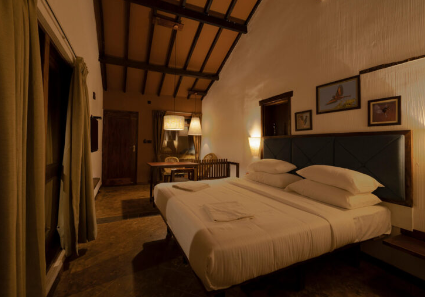
Start with the hornbill, or dhanesh. If any bird runs this forest, it’s this one. You’ll usually hear it long before you see it: a big black-and-white bird with a thick, curved beak and a loud, clattering call. That call carries because of the casque, the odd hollow ridge sitting on top of the beak like a second crest. The one most people spot is the Malabar Pied Hornbill, though its quieter relative, the Malabar Grey Hornbill, lives here too and goes by the same Marathi name.
So why name a room after it? A couple of small reasons. Hornbills do a fair bit of the forest’s gardening: they eat fruit and scatter the seeds across the hills as they go, which is partly how these trees got here to begin with. They’re also loyal. They pair up for life, and at nesting time the female shuts herself inside a tree hollow while the male keeps her fed until the chicks are grown. A bird that fusses that much over its nest felt like the right one for a room built for two. Dhanesh has a queen or twin bed and a veranda of its own; Dhanesh Aangan adds a king bed and a private courtyard on top.
The short version
October to March is peak season — flat sea, open skies, everything running. June to September is the monsoon — drenched, dramatic, half-price, and greener than seems possible. March to May is summer — hot, quiet, and the only time to taste an Alphonso mango straight off the coast that grows it.
When is the best time to visit Sindhudurg?
For most travellers, October to March. The rain has cleared out, the sea lies flat enough for boats and diving, afternoons hold a comfortable 20–32°C, and nothing worth seeing from Sindhudurg Fort to Tarkarli’s beaches is shut. It’s also when everyone else turns up and rates climb, so book early.
Sindhudurg, month by month
The cool season — October to March (peak)
This is the Konkan most people carry in their heads before they ever arrive. The humidity lifts, the haze burns off, and the Arabian Sea flattens into the stillness that makes everything else possible. Afternoons hold around 20–32°C; by dusk you’ll want a shawl on the veranda.
It’s the only stretch when the coast is fully open for business. Boat rides out to Sindhudurg Fort — the sea fort Shivaji built, 31 km from us at Kudal run reliably. Tarkarli, 35 km away, turns on its full slate of watersports, and the scuba diving is at its best, with the clearest underwater visibility of the year in November–December and again from late February into April. If you want beaches without the crowds even now, we’ve mapped ten quiet ones a short drive from the property see 10 Hidden Beaches Near Nest Homestead.
The trade-off is simple: everyone else wants this window too. Diwali fills the coast, New Year fills it again, and the good rooms ours included go early. If your dates are fixed to this season, treat booking as the first thing you do, not the last.
The warm season — March to May (summer)
Then it gets hot. Days climb to 33–36°C and the air turns heavy, which is why most guides tell you to stay away. They’re missing the point.
This is mango season, and on this particular coast that is not a small thing. The Alphonso — the hapus — ripens from late March, peaks from mid-April to mid-May, and tastes like nothing you’ve had off a supermarket shelf. Eating one within a few kilometres of the tree it grew on is a reason to visit in its own right. How good the crop is varies year to year with the rains, so no two summers are identical.
The heat also buys you space. Beaches empty out, prices soften, and if you plan your day around early mornings and long golden evenings — the sea is warm, the light is generous — summer on the Konkan is quietly one of its best-kept secrets. Watersports at Tarkarli generally run into May before the sea closes for the monsoon.
The green season — June to September (monsoon)
And then the rain arrives, and the whole coast changes character. The Sahyadris go a green you won’t quite trust, waterfalls appear where there were none, and the crowds vanish entirely. June is the opening — the monsoon usually sweeps in during the first half of the month and the rain builds quickly, so even early June is properly wet. By August and September it’s at full force; expect serious rain and long days you’ll happily spend watching it from a dry veranda with chai.
Two honest caveats. Watersports and diving at Tarkarli close for the season, and boat services to Sindhudurg Fort are often suspended for safety. And the rain is real — this coast takes several hundred millimetres in a single month, so pack for it. But if greenery, waterfalls like Amboli (46 km) and the calm of Dhamapur Talao (13 km), low prices, and near-total quiet are what you want, nothing else compares. We’ve written the full monsoon playbook separately read Sindhudurg in Monsoon before you come.
The best time for… a quick reference
A quick note, since the word keeps coming up. An aangan is simply a private, open-air courtyard. It’s a Marathi word, and a very Konkan idea: that a house ought to have its own little square of sky and green. It’s where the morning tea happens, and where, more often than not, the birds come to you instead of the other way around.
How to book your room at Lemongrass Nest
- Scuba diving & clear water: season runs October to May; clearest water in November–December and again late February to April.
- Waterfalls & greenery: July to September; Amboli at its most dramatic.
- Alphonso mangoes: April to May.
- Quiet & lower prices: June and September, on the monsoon’s shoulders.
- Festivals: Ganesh Chaturthi (August–September) is the Konkan’s biggest the whole district comes alive. Local jatras cluster in February–March.
A few common questions
Yes — if you come for the right reasons. Through the monsoon (June–September) the coast is soaked, dramatic, empty and cheap. But watersports and fort-boat rides shut down, and the rain is heavy, especially in August–September. Come for the landscape and the hush, not a beach day.
Diving happens roughly October to May and shuts through the monsoon. The water is clearest — and the diving best — around November–December and again from late February into April, when the sea settles and you can see furthest.
Alphonso (hapus) mangoes ripen from late March to early June, with the peak from mid-April to mid-May. The exact window and quality shift year to year depending on the rains, so a strong season and a lean one can look quite different.
Whatever season you land on, the trick is a base in the middle of it all — close enough to reach the forts, the beaches and the ghats without living in the car. That’s exactly where we sit, in Kudal, on the Mumbai–Goa highway, with the whole district within an easy drive. If you’re weighing up where to stay, we wrote an honest guide to that too — Best Resort in Kudal, Sindhudurg. When you’re ready, our rooms — each named for a Konkan bird — are a call away: 7400327111 / 7400308111.